Showing posts with label wikipedia. Show all posts

Sunday, 18 January 2009

Knotted, polka-dotted, twisted, beaded, braided

Once again turning this blog into one about celebrity death, one thing that made sit up and notice this week was the death of Tom O'Horgan, the director of the original Broadway run of the musical 'Hair'.

Sometimes I jokingly say my life is like an episode of 'the Simpsons', with too many pop culture references packed in, but I'm afraid that's true in part. When I look back on years past, one of my ways of telling one year from another, is to think of what bands or films I liked during that time.
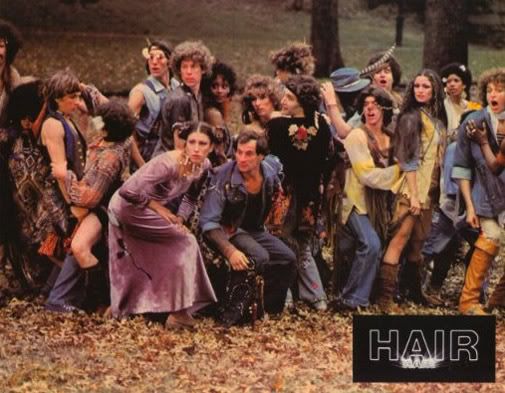

One of my first popular culture obsessions was Hair, the film. I was a bit of a musical-nut when I was little -- I have no idea why. It probably started with watching the Sound of Music and West Side Story on telly with my Mum, and grew from there. I loved the music from Singin' in the Rain (I still hum 'Good Morning' when I'm feeling particularly perky in the morning). This love for musicals, combined with the fact that my oldest brother played a lot of sixties stuff at home, led me to watch Hair as a eight or nine-year-old.

I feel a bit embarrassed to admit this now, but when I was smaller, all I wanted to be was a hippie. I loved the music and the clothes and the fun they all seemed to have. I think I must have rented Hair numerous times, I absolutely loved it. I had the soundtrack of the musical (with Diane Keaton singing!) and pretty much cried every time 'The Flesh Failures/Let the Sun Shine In' came on, thinking of poor Berger.
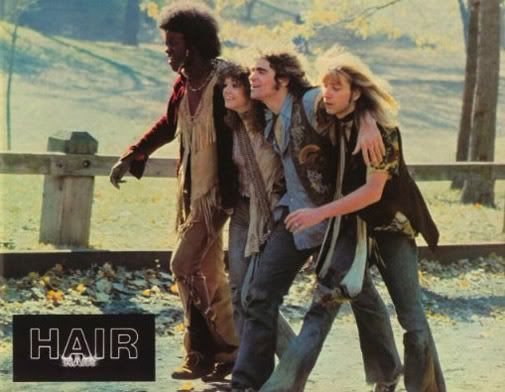

Reading up on Wikipedia while watching the movie last night, it struck me that the writers of the musical didn't approve of the film, saying that Milos Forman completely missed the plot. I've never been to see the musical (or any musical, period) but apparently there's a lot of differences between the film and musical; obviously I can't judge properly, but this scene alone makes it unfair to dismiss the film like James Rado and Gerome Ragni did:


A bit heavy on the symbolism, eh? It's always struck me as really odd that 'Let the Sun Shine In' is used for commercials and crap techno remixes these days; I always associate it with the ending of the film, where 'Let the Sun Shine In' is prefaced by 'The Flesh Failures', one of the most sucker-punchiest of musical songs:


I didn't realise until Baz Luhrman's Romeo + Juliet came out that the song uses Romeo's farewell speech as a backing choir. The Vietnam war took place long before I was born, but somehow, just because of 'The Flesh Failures', those marching soldiers (and the 'Wonder Years' television series) have always made that war feel the closest to home. It's strange what power film, television and music have in that way.
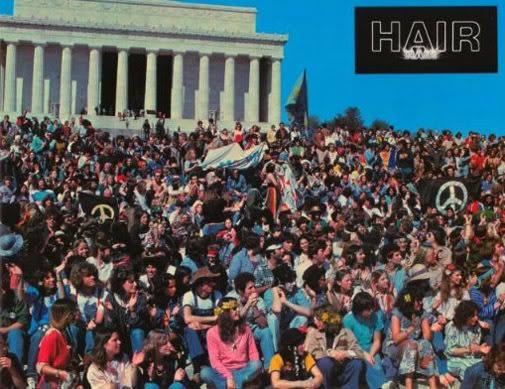

Anyways, rest assured, my dreams of becoming a hippie are long gone; these days when I watch Woodstock, I can only notice the bandwagon-y nature of the whole subculture and the role drugs played in it all. Sitting in a field while having drugged-out, partially-clad people crowd surf all over you (like in Gimme Shelter)? No thanks, I think I'll pass.


Finally, two more of my favourite songs:
· Black Boys / White Boys.
· Cheryl Barnes' beautiful rendition of Easy to Be Hard.

Thursday, 11 December 2008

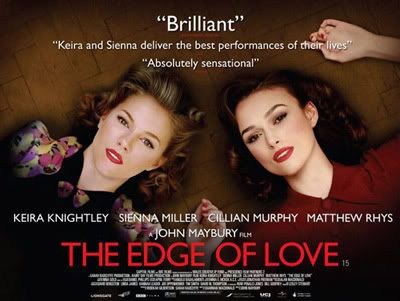
The Edge Of Love (2008, John Maybury)

Well, I certainly didn't mean to disappear from this blog for over a month. Sorry about that, I started a new job and rather got carried away in all the excitement, heh.

--

Last week, rather unexpectedly, I read about Richey James Edwards being officially declared dead after having been missing for nearly fourteen years. I should say the timing was unexpected, because ever since becoming a fan of the Manic Street Preachers in 1999, I didn't think there was much of a chance of Richey still being alive.


While it wasn't surprising, it did still make me feel rather uncomfortable. Whenever I think about the Manics, I think about that terrible quote from Nick Hornby's 'High Fidelity': "what came first, the music or the misery?". Let's not dwell on the misery-bit, there, but it's a strange thing to think about my personality would have been had I not become a fan of the Manics. They influenced me very much when I was a 12-year-old, and I'm happy that they did because without them, I wouldn't have known about Abraham Zapruder, S.E. Hinton and Harold Pinter when I did.

Coming from Wales, the Manic Street Preachers also introduced me to a whole range of Welsh literary heroes I'd never heard about, one of them being Dylan Thomas, most famous for writing the play for voices, 'Under Milk Wood'.


It was strange to hear about Richey James when I did, because the weekend before I had just seen The Edge of Love, a Dylan Thomas-biopic of sorts that focuses on his life during and shortly after the Second World War, when he lived with his wife, his childhood sweetheart and her soldier husband in Wales. Starring Matthew Rhys as Thomas, Sienna Miller and Keira Knightley fight for his affections as Caitlin MacNamara and Vera Phillips, Thomas' real-life wife and ex-lover.


It's very tempting to compare The Edge of Love to Atonement, since both are very British films, set in the 1940s and star Keira Knightley, but that would be an unfair comparison. While I did very much enjoy Atonement, The Edge of Love is more human and it's about the relationship between four people instead of Atonement's good versus evil; sensationalism aside, the viewer gets more emotionally involved with The Edge of Love. This film is about flawed people instead of angelic Robbie Turner, and it stays with you because of the great performances and beautiful locations.

Keira Knightley already won me over with her performance in Bend It Like Beckham and Atonement, but as the opening credit rolled, I felt unsure about Sienna Miller. To be honest, I always considered Sienna Miller to be one of those actresses who become famous by pretty much playing themselves in a few films that are released in the same year, launching them to flavour-of-the-month-fame. Steve Buscemi's take on Theo van Gogh's Interview already garnered Sienna Miller good reviews, but since I disliked the original, I found the film unbearable watch.

Not to give away too much, Miller gives an amazing performance, out-shining everyone else on the screen. Those last moments between Catty and Vera are just heart-wrenching; a great moment in 2008 cinema.


Thursday, 11 September 2008

Saul Bass

As I was walking home yesterday, I came across a poster for Pluk de Nacht, a film festival in Amsterdam that shows previously unreleased films. I was walking by and not paying much attention, but still the poster caught my eye and I immediately thought of Saul Bass.


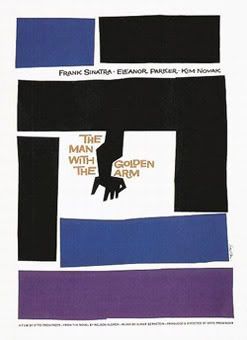
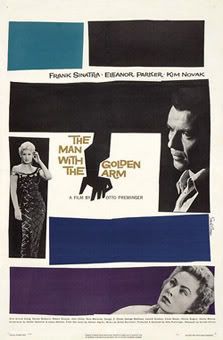
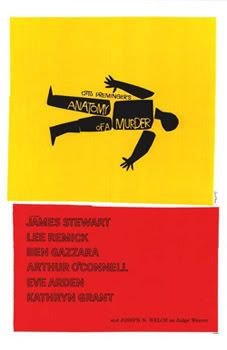
Saul Bass was a graphic designer, most famous for his work on film posters for Alfred Hitchcock, Stanley Kubrick and Martin Scorsese; his most iconic poster might just be the one he made for Otto Preminger's The Man with the Golden Arm:


Bass was also very well known for his amazing animated title sequences for several films; Hitchcock's Vertigo and Psycho of course, but also 1991's GoodFellas and even The Age of Innocence - how's that for diversity? My favourite is the title sequence he made for North by Northwest, it's just genius:


Before he started working on films, Bass was already a sought-after graphic designer. In his lifetime he created corporate identities and logos for companies such as Continental Airlines, the Girl Scouts of the USA (!), Wesson Oil and Geffen Records. Wikipedia reports that at one point, his AT&T Bell System logo had a 93 percent recognition rate in the United States.

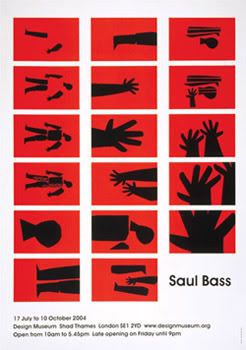
Saul Bass is a legend in graphic design, you can find an interesting biography with a timeline of his major works on the Design Museum's website.


More interesting websites and blogs on Saul Bass:
· saulbass.tv: a very stylish website dedicated to saul, focusing mostly on his poster designs.
· cinemacom.com/saul-bass: a collection of his film posters.
· a great post on Design*Sponge about Saul Bass' children's book, 'Henri's Walk To Paris'.

Plus, I highly recommend these YouTube-videos:
· a little gem that popped up on YouTube a few months ago: Saul Bass vs Star Wars
· opening sequence from Anatomy of a Murder
· opening sequence from The Man With the Golden Arm
· opening sequence from Vertigo


Friday, 5 September 2008

Bill Meléndez

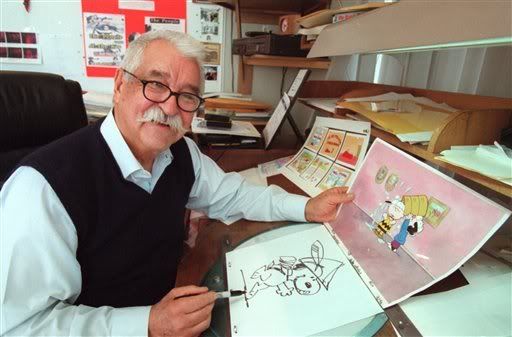
I realise this blog is soon becoming a blog of celebrity death, but I was sad to hear Bill Meléndez, the man responsible for the many 'Peanuts' and Charlie Brown TV animations, had died.


Growing up I was always a fan of Charles M. Schulz's cartoons, and I would cut the comic strips out of our newspaper and stick them in my notebooks. Linus and Lucy were (and still are) my favourite characters, and I love the way they're portrayed in the animation series. Apparently José "Bill" Meléndez was the only person Schulz would allow to work on the animation of his comic strips. He made five feature length Charlie Brown films (the most famous of which is the A Charlie Brown Christmas), and 75 half-hour cartoons.

Despite being best remembered for his work on bringing the 'Peanuts'-characters to the screen, Meléndez also worked on Walt Disney's Bambi, Fantasia and Dumbo, as well as several Bugs Bunny and 'Looney Tunes'-cartoons.

Here's one of my favourite scenes from A Boy Named Charlie Brown, the first feature length 'Peanuts'-film; every animation feature should contain one mind-bogglingly psychedelic scene (think of the elephant dance in Dumbo) -- here Schroeder plays Beethoven's 'Sonata Pathetique' (it starts about 45 seconds in):


Also, something I found really surprising and fun to find out: Meléndez was also the producer for Babar Comes to America, which is voiced by the late, great Peter Ustinov (who is unforgettable as King John in Disney's Robin Hood). Babar was my one great love as a little girl and I will be the first to admit I'm a bit of a Babar-purist (Jean de Brunhoff's books are the only real Babar-books in my mind, Laurent's were rubbish), and I was horrified to see the 1980s animation series as a semi-grown up a couple of years ago but, still, Laurent-Babar is better than no Babar at all!

Mr. Meléndez, I salute you.

Tuesday, 5 August 2008

Harvey Milk


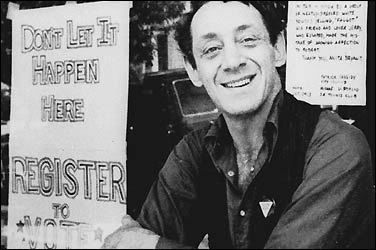
IMDb reports that Gus Van Sant's next film, Milk will be out in the U.S. in December 2008. It will tell the story of Harvey Milk, "the first openly gay man elected to any substantial political office in the history of the planet" (according to Time-magazine), who was murdered, along with then-Mayor of San Fransisco, George Moscone, by their recently-resigned colleague Dan White.

Dan White only served seven years and some months for this double murder, and his trial became infamous for the Twinkie defense; despite having always been a health-nut, White had recently taken up eating Twinkies and drinking Coca-Cola, and White's attorney claimed he had murdered Harvey Milk and George Moscone because the junk food had worsened his depressed mental state.


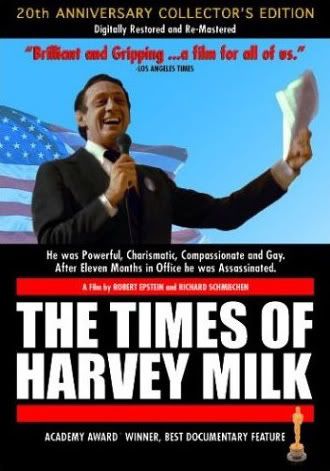
If you have the time, I highly recommend the Academy Award-winning documentary The Times of Harvey Milk, which you can watch in parts on YouTube. It features a lot of archive footage of Milk, speaks with his campaign workers and it gives an insight into the emancipation of gay men and women in San Fransisco in the 1970s.

Sunday, 1 June 2008

flickr favourites #5


originally uploaded by BrigitteChanson.

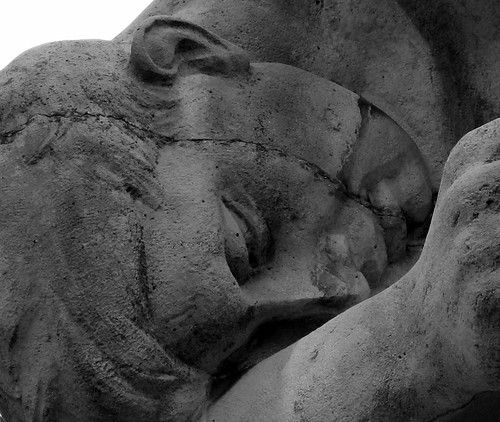
Le monument aux victimes civiles fusillées en 1914

Since I don't really take myself serious as a photographer (I like taking photos, but nothing more than that), I don't really take time to share my photos in the pools set up on Flickr, but yesterday I got a comment on one of my photos of a war memorial in Tourcoing, asking if I'd like to add it to a new Flickr pool dedicated to Monuments aux Morts -- French War Memorials, usually dedicated to those who died during the First World War.

There's some really striking images in this new pool, and I hate to make any generalisations as to why French memorials are so stunning, but please have a look through the photos. On the Wikipedia entry for War Memorials', you get an impression of all the different kinds of War Memorials different countries have erected over the years.

With 'On Passing the Menin Gate' by Siegfried Sassoon in mind, I have to say that those big plaques listing the names of those who died, make me feel terribly uncomfortable. I think that, in a way, those long, long lists of names do little to really focus on all of the lives lost -- the names are there, but that's it. I think the statues that really depict people, like the one in BrigitteChanson's photo, bring across a much stronger, universal image of grief and mourning, without being clichéd. It's important to honour the soldiers who died, of course, but memorials like the one in Tourcoing make you remember why it's important.


originally uploaded by stagedoorjohnny.

That memorial in Tourcoing is the most beautiful memorial I've ever seen, it reminded me of 'The Raft of the Medusa' by Théodore Géricault -- walking around the statue you go from seeing the wounded and dying soldiers at the base of the statue to the struggling, and as they get nearer to the top, the soldiers walk more upright and it ends with (I suppose) Victoria or Nike on her horse leading them to triumph. I suppose at the end of the day it's still a form of wartime propaganda, but still, it's quite immense.

Sunday, 13 April 2008

he fills it only halfway and before i even argue

Sunset Boulevard. is probably the film with the most amazing collection of fun trivia, and I could make a post with a number of fun facts; about how Gloria Swanson introduced Dirk Benedict to macrobiotic diets in the 70s, how Erich von Stroheim (who played Max the butler) directed the silent film Norma and Joe watch on the projector (Queen Kelly, which had signified the end of Gloria Swanson's career in real life, just as it did Norma's in the film), or how Cecil B. DeMille greets Gloria Swanson with his real-life nickname for her - "Young Fella" - because she was braver than any man..

Instead I'll make a post about Suzanne Vega because (am I the only person who knows 'Tom's Diner' word-for-word?), I always think of that song when I watch the film. The actor mentioned in the song - "I open up the paper // There's a story of an actor // Who had died while he was drinking // It was no one I had heard of" - was William Holden, who plays Joe Gillis in the film. Apparently Holden was a heavy drinker and at the age of 63 he was home alone when he slipped on a throw rug, cut his head open on a bedside table and bled to death. Poor guy.
Anyways, Suzanne Vega's official site actually has an entire section dedicated to "fun facts" which, quite frankly, is absolute genius. Everyone should have their own "fun facts"-section.
Suzanne has been referred to as the 'Mother of the MP3' as it was her voice that was used as the model for Karlheinz Brandenburg's compression algorithm. From Business 2.0 Magazine:
'To create MP3, Brandenburg had to appreciate how the human ear perceives sound. A key assist in this effort came from folk singer Suzanne Vega. "I was ready to fine-tune my compression algorithm", Brandenburg recalls. "Somewhere down the corridor a radio was playing [Vega's song] 'Tom's Diner'. I was electrified. I knew it would be nearly impossible to compress this warm a capella voice."
Because the song depends on very subtle nuances of Vega's inflection, the algorithm would have to be very, very good to select the most important parts of the sound file and discard the rest. So Brandenburg tested each refinement of his system with 'Tom's Diner'. He wound up listening to the song thousands of times, and the result was a code that was heard around the world. When an MP3 player compresses music by anyone from Courtney Love to Kenny G, it is replicating the way that Brandenburg heard Suzanne Vega.'

Saturday, 22 March 2008

william haines


From Wikipedia:
William Haines was born to a wealthy family in Staunton, Virginia, left home at the age of 14 and moved to New York City. After winning a talent contest he moved to Hollywood where he played bit parts for several years until MGM Studios began casting him in more prominent roles.

By 1925 he was MGM's most important male star, and his films were very profitable for the studio. He was cultivated as a romantic leading man, and his combination of good looks and flair for comedy won him many fans. He made a career out of playing wise-cracking young athletic types whose large egos hold them back until an attitude adjustment leads to success.

He appeared in hits such as The Midnight Express (1924) with Elaine Hammerstein, and Sally, Irene and Mary (1926) with newcomers Joan Crawford and Constance Bennett. Haines scored his biggest personal successes with Brown of Harvard (1926) opposite Jack Pickford and Mary Brian, and Little Annie Rooney (1927) with Mary Pickford and Vola Vale, and Show People (1928), co-starring Marion Davies. Haines was a top-five box office star from 1928 to 1932. He made a successful transition into talking pictures in the part-talkie Alias Jimmy Valentine (1928). His first all-talkie, Navy Blues, was released the following year.

Haines lived openly as a homosexual. Starting in 1926, Haines lived with Jimmy Shields, whom he had met when Shields was his stand-in during the production of a film. Studio publicists were able to keep Haines' sexual orientation from the press.

In 1933, Haines was arrested in a YMCA with a sailor he had picked up in Los Angeles' Pershing Square. Louis B. Mayer, the studio head at MGM, delivered an ultimatum to Haines: choose between a sham marriage or lavender marriage, or his relationship with Shields. Haines chose Shields and were ultimately together for 50 years. Mayer subsequently fired Haines and terminated his contract, quickly recasting Robert Montgomery in roles that had been planned for Haines. Haines did make a few minor films at Poverty Row studios, then retired from film. His final films were made with Mascot Pictures, Young and Beautiful and The Marines Are Coming in 1934.

Haines and Shields began a successful career as interior designers and antique dealers. Among their early clients were friends such as Joan Crawford, Gloria Swanson, Carole Lombard, Marion Davies and George Cukor. Their lives were disrupted in 1936 when members of the Ku Klux Klan dragged the two men from their home and beat them, because a neighbor had accused the two of propositioning his son. Crawford, along with other stars such as Claudette Colbert, George Burns, Gracie Allen, Kay Francis and Charles Boyer urged the men to report this to the police. Marion Davies asked her lover William Randolph Hearst to use his influence to ensure the neighbors were prosecuted to the full extent of the law, but ultimately Haines and Shields chose not to report the incident.

The couple finally settled into the Hollywood community in Malibu, and their business prospered until their retirement in the early 1970s, except for a brief interruption when Haines served in World War II. Their long list of clients included Ronald and Nancy Reagan when Reagan was governor of California.

Haines never returned to films. Gloria Swanson (another lifelong friend) extended him a personal invitation to appear with her in the film Sunset Boulevard (1950) but he declined.

Haines and Shields remained together for the rest of their lives. Joan Crawford described them as "the happiest married couple in Hollywood".

Haines died from lung cancer in Santa Monica, California at the age of 73. Soon afterward, Shields, who suffered from what many believe to be Alzheimer's Disease, put on Haines' pajamas, took an overdose of pills, and crawled into their bed to die. They were interred side by side in the Woodlawn Memorial Cemetery.

William Haines has a star on the Hollywood Walk of Fame at 7012 Hollywood Boulevard. His life was detailed in William J. Mann's critically-acclaimed 1998 biography, 'Wisecracker: The Life and Times of William Haines, Hollywood's First Openly Gay Star'.

Monday, 17 March 2008

Raise the Titanic (1980)

Last night, my Dad and I got sucked into watching Raise the Titanic on the BBC and reading the reviews online now, I feel like we might have watched a different film because I really enjoyed it.

Based on the 1976 book by Clive Cussler, the film was released in 1980. The basic plot revolves around adventurer Dirk Pitt (Dirk Benedict! Dirk Bogarde! Dirk Diggler! An impressive list of Dirks on Wikipedia) who has to find a very rare mineral which, conveniently, is locked inside Cargo Nine on the Titanic. What ensues is this strange Cold War-espionage, deep sea-diving "thriller", with lots of heavy wool sweaters and beards all 'round.

What makes this film enjoyable, aside from the majestic John Barry-score, is the fact that the book was written nine years before the wreck of the Titanic was actually discovered. Since I was a 12-year-old girl back in 1998, of course I went to see Titanic in the theatres (February 22nd, ten years ago!) and became quite obsessed with all the National Geographic-y documentaries on the subject. It was really great to watch Raise the Titanic as a fantasy of what might have been; of course, watching it now, the whole plot is entirely implausible because the ship broke in two as it sank.

BBC teletext promised us Sir Alec Guinness, but he's in it for all of five minutes. The film flopped at the box office - it cost 36 million dollars to make, and the original US box office gross was only seven million - "When discussing the film's cost, producer Lew Grade famously said that it would have been cheaper to lower the Atlantic."

Another fun fact, courtesy of IMDb: "A model of the Titanic was built at a cost of $350,000. When it was finished, it was discovered that it was too big for the tank in which it was to be filmed. An additional, bigger tank had to be built, at a cost of $6 million."

Anyways, here's the best bit from the film:

And for those interested, a reenactment in LEGO can be found here.

Saturday, 15 March 2008

Flickr Favourites #2


originally uploaded by Sister72.

It's not quite up there with Christmas, but still, I love Easter, and apparently they love Easter in Asbury Park, NJ as well.

Asbury Park is one of my favourite places on earth. A couple years ago, my parents and I decided to drop off there on our way from Washington D.C. to Philadelphia as a kind of a joke: my Bruce Springsteen-fixation was only starting up then and so as a joke (because he named an album after the place) I said, "why don't we go to Asbury?". When we got there, we were in for a surprise - since the early 2000s, they've started up this whole regeneration-project around that area, but when we got to Asbury Park in May 2006, it was still all urban decay, demolished buildings and faded seaside glamour. When we returned in July 2006, they'd done some painting, cleared up the scrap metal from the Building C-8 demolishment and there was a new mini-golfcourse on the Boardwalk, but still. In the 1920s, it was one of the most popular seaside resorts, but after the Great Depression and World War II, it never quite recovered.

Sister72 is one of my other Flickr-favourites, she lives around the Asbury Park-area, and frequently posts photos of life around Monmouth County, NJ. It's great to see little snippets of every-day life of such a special place. There's a lot of history to Asbury Park (this is one of my favourite sites about the town), and it's great to read people's own histories of the place in the comments to Sister72's photos.

To end this post (I could go on and on), a video by EarlyFilms:

Wednesday, 5 March 2008

John Everett Millais


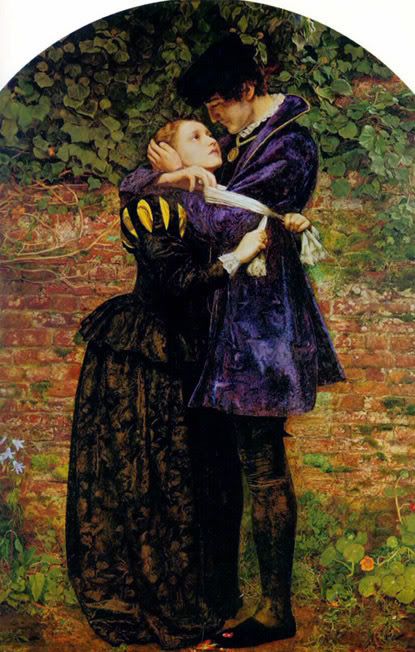
John Everett Millais, A Huguenot, on St. Bartholomew's Day, Refusing to Shield Himself from Danger by Wearing the Roman Catholic Badge (1852)

From Wikipedia:
It depicts a pair of young lovers in an embrace. The familiar subject is given a dramatic twist because the "embrace" is in fact an attempt by the girl to get her beloved to wear a white armband, declaring his allegiance to Roman Catholicism. The young man gently pulls the armband off with the same hand with which he embraces the girl. The incident refers to the St. Bartholomew's Day massacre in 1572 when French Protestants (Huguenots) were massacred in Paris, leading to other massacres elsewhere in France. A small number of Protestants escaped from the city by wearing white armbands.

I saw this painting at the Van Gogh Museum this afternoon - while at first look it appears to be just another painting of two young lovers, those three fingers hooked in that armband are so subtle that it turns the painting into one of the most heart-wrenching I've ever seen.

The detail in John Everett Millais' paintings is extraordinary - at times the leaves in his paintings look so realistic, it's like someone got a bit overzealous with the 'sharpen details'-tool in Adobe Photoshop. Most of the reproductions you find on the internet or in books are absolutely horrendous, though, they don't do Millais justice - that purple jacket is so vibrant; the colours he used caught your eye from across the room, they're impossible to reproduce.

Sunday, 2 March 2008

to start things off..

The Stranglers, La Folie (1981)


Moodiest-looking video in existence? Perfect for a sunny afternoon!

Fun fact: according to Wikipedia, this song was inspired by Issei Sagawa, a Japanese cannibal whom I share a birthday with. Jacques Cousteau, one of the Pointer Sisters, Issei and me, June 11th, mark your calendars.